ASA May 2026 Issue
Editorial
If Gauteng’s weather lately has felt like a metaphor, it’s because it is. One day blazing heat, the next a sudden downpour that catches everyone off guard. The climate, it seems, is no longer content to be predictable – and neither, frankly, is anything else. Petrol prices climbing again. An AI policy framework floated, debated, and quietly reversed before the ink had dried. The news cycle in South Africa right now demands a certain resilience just to keep up with it, let alone make sense of it.
And yet, amidst the noise, this issue asks us to lift our gaze.
Sustainability and ESG take centre stage this month – not as a retreat from the turbulence, but as a response to it. Because if the chaos of the current moment tells us anything, it is that the old ways of doing business, of reporting, of measuring value, are no longer adequate. The world is asking harder questions, and our profession is increasingly expected to answer them.
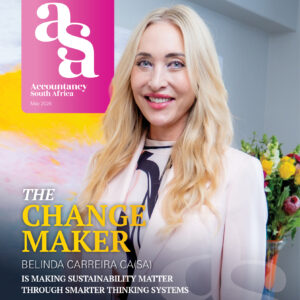
Belinda Carreira, founder of SustainableDNA and SAICA’s inaugural Chairman’s Difference Makers Award winner for sustainability, challenges us to think beyond compliance and beyond sustainability itself – towards regeneration, towards systems that give back more than they take. It is a compelling vision, and one that places CAs(SA) squarely at the heart of the transition.
Our feature section deepens this conversation, examining how financial services can integrate business into nature, how the ISSB’s new standards can be embedded in integrated reporting, what a maturing assurance landscape demands of the profession, and what IFRS S1 and S2 mean practically for JSE-listed entities. Taken together, they offer a roadmap – from the boardroom to the balance sheet to the audit opinion.
And then there is Thabo Limema – a profile that stops you in your tracks. A CA(SA) by training who found his calling at the intersection of corporate life and social justice, Thabo has become one of South Africa’s most prominent male voices in the fight against GBV. His credentials speak for themselves: in 2025 he participated in the G20’s Empower of Women Working Group, and he was recently one of only two men recommended by the Portfolio Committee on Women, Youth and Persons with Disabilities to serve on the National Council on Gender-Based Violence and Femicide board (the statutory body that oversees South Africa’s entire national response to the crisis). His argument is as uncomfortable as it is necessary.
In pursuit of meaningful impact,
Kgauhelo Dioka
Editor: Accountancy SA