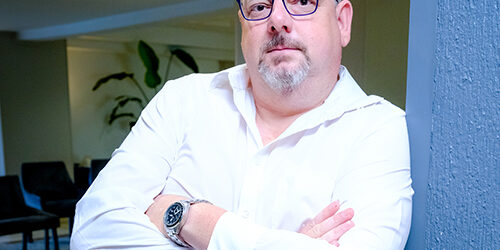
Andrew Alt helps developers and finance professionals understand each other. He sees AI as powerful but with limitations, useful for structured tasks but no substitute for human judgement. His message to newly qualified CAs(SA) is to think broadly, question assumptions and understand how systems work. In a profession being reshaped by rapid technological change, adaptability and curiosity will be career defining.
ANDREW ALT COMES FROM A HUMBLE background. An only child, he was raised in Queenstown (now Komani) in the Eastern Cape by a single mother.
Despite these early hardships, he was regularly top of the class at school. ‘I loved words,’ he says. ‘I wanted to be an actor. I wanted to write the great South African novel. I wanted to be a published poet with something important to say about the world.’
But when he applied to Rhodes University reality set in. ‘Drama students were watching each other’s auditions. Sitting there, I realised that most of the people around me were far more talented than I was. As much as I loved acting, I was not the best at it.’
At school, he had enjoyed computer science. Programming was logical and practical; it made sense. He decided he would make a living from that rather and enrolled at NMMU (then UPE). But life had other plans for him. ‘I was chatting to a friend on registration day and ended up being in the wrong queue, so I accidentally signed up for a CA slash BSc degree. And that’s how I became an accountant.’
At the time, he was studying computer science, − the course contained pure maths and classical Greek logic. His BSc lecturers insisted that if he was to study the logic of programming, Aristotle was the place to start.
‘That mix of subjects changed my perspective,’ he says. ‘Accounting is technical and rules based. It teaches compliance, standards and precision. Computer science looks at systems from multiple angles. It asks how parts connect, how inputs produce outputs, and what happens when one variable shifts. It’s more about understanding whole structures.’
‘I don’t think CAs(SA) are numbers people,’ he says. ‘I think we’re translators.’
‘A good CA(SA) can sit across from a small business owner and make a set of financial statements make sense, strip away the jargon, and show people what matters. This is where there are similarities with programming. When something breaks, you do not fix the surface problem and move on. You trace it back and identify the systemic problem that allowed it to happen.’
MAKING A CAREER CHANGE
Alt completed his articles at Charteris & Barnes in the Eastern Cape and went on to become a partner. He stayed with the firm for more than two decades. In addition to audit work, he took responsibility for IT and infrastructure and was comfortable working with large volumes of data. He admits he did not always fit the traditional mould of a practice partner, but he focused on the areas where he added value.
At 47, he chose to step away from the profession. The pressure had been building for years, as regulation increased and responsibility continued to grow. Burnout was becoming normal. Then a serious health scare made him stop and think seriously about what he wanted next.
‘I don’t think you’re a real accountant until you’re driving to work in traffic and you think to yourself, “you know, if I just slip into this oncoming lane, the pain will end.” So, I left without much of a plan other than to lie by the pool and have a few beers.’
Before leaving the firm, he received a call from Draftworx, the financial reporting and audit software company his firm had used. The CEO asked if he would consider coming on board.
The next day he was offered a job with the title line left blank. Alt filled it in, half-jokingly, as Chief Imagination Officer. The name stuck. He works between coders and accountants, translating accounting requirements into practical instructions for developers, and explaining technical limits and possibilities to finance professionals.
‘When our product teams build new features, I can anticipate where an accountant might struggle with a workflow or where a developer might misunderstand how a reporting standard is applied in practice,’ he says. ‘When our larger clients are implementing the system, I help them understand how it fits into their existing processes and what changes they may need to make. This bridges a gap that often causes friction in audit software development.’
Finance and technology are now tightly connected, Alt says. ‘CAs(SA) can no longer treat technology as something separate from their profession. A working understanding of how technology functions is essential, not optional.’
AI IS CENTRAL TO THE CONVERSATION
Alt believes AI is powerful but overhyped. In finance, he says, it works best in clearly defined, rules-based environments. Financial systems have playbooks and they operate within structured frameworks. That makes them suitable for machine learning tools that can process repetitive tasks and flag anomalies. But he’s cautious about exaggerated claims.
‘AI can handle rule-based work and large volumes of data. It can speed up repetitive processes and surface information that might otherwise be missed. What it cannot do, at least not yet, is replace judgement or human nuance. It does not carry lived experience. It does not understand context in the way people do.’
He sees its role as reducing the time spent on routine work so that professionals can focus on higher-value conversations. In his words, it can give you a ‘heads up’ about what matters.
He also draws a distinction between broad, general large language models and more specialised AI tools. ‘Specialised AI applied to specific problems in finance is more useful than systems that attempt to be all-purpose solutions. Data privacy and data quality remain real constraints.’
Systems thinking has always helped him understand risk more broadly, and where the gaps lie.
The risk lies not in AI itself, but in ignoring it. ‘Professionals who refuse to engage with it will become inefficient. At the same time, those who assume it will solve everything sorely misunderstand its limits.’
His advice to young CAs(SA) is consistent with how he developed his own career.
‘First, do not specialise too early. Many graduates narrow their focus before they have properly understood the breadth of the profession. A broader base creates stronger professionals in the long run. It’s like studying medicine – general training first, specialisation later.’
He encourages young professionals to be deliberately curious and to read widely. ‘Not only tax updates or accounting standards, but history, science and ideas that challenge your own views. Makes a point of reading arguments you disagree with so you can understand other points of view.’
For Alt, modern risk is tied to polarisation and algorithm-driven media. ‘The real risk in our current environment is intellectual complacency. If you do not actively step outside your own echo chamber, you distort your understanding of what may affect markets, clients and business decisions. Social platforms and digital news feeds reinforce existing beliefs. For CAs(SA), that has an impact on professional judgement,’ he says.
‘Risk is not only about numbers. It is political, social and behavioural. If you only see one side of an argument, a dispute, an ideological position, a political opinion, you are highly likely to miss something.’
Author
Monique Verduyn