Around the world, tax clinics have had a massive impact on those whose lack of access, assistance and understanding have hampered their ability to participate in the tax system. Now, following two years of close collaboration and research between key stakeholders, South Africa is ready to follow suit.
‘When access to taxpayer support depends on how much you can pay or how confidently you are able to use technology, or the level of your knowledge, inequality is the inevitable outcome,’ observes Dr Kerry de Hart, manager of Unisa’s Online Tax Clinic and a senior lecturer in taxation at the university’s School of Accountancy.
This is one of the reasons Unisa joined forces with the University of Pretoria (UP) and the Tshwane University of Technology (TUT) to establish SA Tax Clinics. Other stakeholders involved in the project include SAICA, the Office of the Tax Ombud, SARS and other controlling bodies, ensuring that the project includes as many outlooks and interests as possible. Professor Hanneke du Preez of the Department of Taxation at UP’s Faculty of Economic and Management Sciences points out that to ensure that more perspectives were included, the project’s steering committee consulted with lecturers, heads of department, the deans of commerce faculties. and executive committee members of Universities South Africa (USAf).
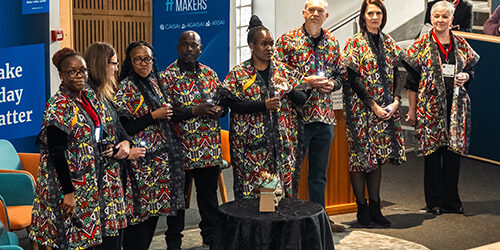
It has been an intense process, she admits, spanning two years – but the results have been worthwhile, leading to the launch of SA Tax Clinics on 28 July, at the 11th International Conference on Taxpayers Rights.
PRACTICE AND PREPARATION
Jointly hosted by UP and the US’ Center for Taxpayers’ Rights and sponsored by SAICA, this is the first time the event has been held in Africa. Attendance
by several of the industry’s luminaries, including Nina Olsen, the Center’s Executive Director, who introduced tax clinics to the United States in the 1970s, as well as Annette Morgan and Donovan Castellyn, who were instrumental in implementing the tax clinic model in Australia, makes this a particularly significant event for South Africa’s tax fraternity.
It also means that this is an especially auspicious
platform for the launch of South Africa’s own tax clinic initiative, says Pieter Faber, Head: Tax at SAICA. ‘Taxpayers’ rights are a fundamental part of the tax profession,’ he points out, adding that the consideration of rights provides a springboard for tax professionals to think about the role they play in society.
Faber is pleased that, apart from its role in improving accessibility for excluded taxpayers, the project presents an opportunity for tax students to gain valuable experience in a safe environment, with tax practitioners on hand to provide supervised guidance and practical mentoring. More than simply handling less complex matters, participating students will be grappling with questions related to ethics and morality; multifaceted issues which they are certain to encounter as their careers progress. ‘This is crucial preparation for difficult situations they may face in the future,’ he says.
Above all, Faber adds, the tax clinics continue SAICA’s legacy of reaching out to South Africa’s vulnerable and disenfranchised. Projects like Thuthuka and The
Hope Factory were established to aid the disadvantaged, and SAICA’s involvement in the clinics builds on this tradition; in the process, forging a generation of practitioners who understand the importance of giving back to society.
SYMBIOTIC RELATIONSHIPS
SAICA’s involvement points to the collaborative nature of the project, which Du Preez maintains is one of its strengths. ‘Our tax clinics are based on the Australian model, because it most closely reflects the dynamics present in our country,’ she explains. ‘Against this backdrop, each clinic is headed by a professional tax practitioner. Our tax clinics therefore work alongside the industry, rather than competing with it, to create a strong, supportive and symbiotic relationship.’ This symbiosis is mirrored in SA Tax Clinics’ relationship with SARS, with the clinics continuing the work of the regulator’s mobile units by reaching out to taxpayers in underrepresented areas. That said, because the clinics are based at universities, they maintain their independence – important, because as Du Preez points out, many taxpayers feel too intimidated to approach the national regulator.
FAR-REACHING BENEFITS
The independence of the clinics means that each university is able to design their tax clinics in a way that best serves the surrounding community. For example, the Mamelodi-based tax clinic hosted by UP is an in-person facility, while the unit run by TUT functions as a hybrid of online and in-person. The Unisa Online Tax Clinic is, at its name suggests, entirely online – a first in South Africa and perhaps even the world, says De Hart. ‘This means that our clinic students, volunteer tax practitioners and taxpayer clients are all geographically dispersed,’ she points out.
Like UP and TUT, Unisa is using the pilot phase of the project to test systems. The outcomes and experiences will be discussed amongst the founding members of the project in November 2026, Du Preez informs, when they will also investigate ways to improve functioning or address areas of improvement.
From there, the goal is to scale the scope of each clinic. De Hart explains that, for the Unisa Online Tax Clinic, this means expanding the initiative so that all PG Dip Taxation students can benefit from the experience; while also increasing the types of cases handled by the clinic. ‘This year, we’re focusing on auto-assessments, but in the future, we would like to assist a wider range of unrepresented taxpayers with broader services. The clinic will particularly aim to assist small businesses, because we acknowledge their importance to the economy and the likelihood that their owners often lack the tax knowledge required to comply,’ she says.
The SA Tax Clinics’ footprint is also set to expand, with plans to establish a clinic at every university in the country. The University of Limpopo has been the first to come on board, launching its initiative on 24 July.
The work of the tax clinic is essential, De Hart comments. ‘Unassisted taxpayers often accept an incorrect assessment outright or make errors trying to fix it themselves, both of which undermine compliance and place unnecessary strain on SARS’ systems. Tax clinics can fill this gap. They are a means to get accurate, supervised assistance at no cost.’
‘We hope the project will expand voluntary tax compliance and education, from tax registration to ensuring tax payments are up to date and tax claims are complete,’ Faber concludes.
Author
Lisa Witepski